
What Is Business Transformation? Definition, Types, Examples
Business transformation has become one of the most searched and misunderstood concepts in modern leadership. Organizations invest millions in transformation programs and business transformation consulting services, yet many still struggle to turn change into lasting results.
So, what is it exactly, and why does it fail so often?
In this article, we define business transformation in practical terms, explain its main types, clarify the role of business transformation consultants, and show how strategy, Enterprise Architecture, and AI must work together to make transformation stick.
Table of contents
What is business transformation?
Types of business transformation
Business transformation strategy explained
Why business transformation fails so often
What do business transformation consultants actually do
Business transformation consulting services today
The role of Enterprise Architecture and solution design
AI business transformation
Examples of business transformation in practice
Choosing the right business transformation consultancy
From transformation initiatives to transformation capability
Key takeaways
FAQ
What is business transformation?
Business transformation is the deliberate, organization-wide change of how a company creates value, operates, and competes over time. Unlike isolated change initiatives, it connects strategy to execution through a shared enterprise context. When this connection is missing, organizations fall into transformation theater, an activity that looks productive but delivers little sustained impact.
This is why modern business transformation relies on Enterprise Architecture (EA) as a decision foundation rather than just documentation. EA helps guide change across the organization.
Types of business transformation
Digital transformation
Digital transformation modernizes systems, platforms, and data to improve efficiency, experience, and agility. However, it succeeds only when grounded in an enterprise context. Without architectural insight, digital initiatives often accelerate fragmentation rather than deliver value.
Operating model transformation
Operating model transformation reshapes how work flows across the organization. This can include new team structures, governance models, and delivery approaches. Business transformation consultants often rely on architecture to anticipate cross-team impacts before these changes are made.
Business model transformation
Business model transformation introduces new ways to create and capture value, such as subscription services, platform models, and ecosystem partnerships. These transformations depend heavily on understanding enterprise capabilities, dependencies, and customer value streams.
Cultural transformation
Cultural transformation focuses on behaviors, decision-making norms, and ways of working. Culture becomes sustainable when supported by shared visibility and transparent decision-making, not by slogans or mandates.
Business transformation strategy explained
A strong business transformation strategy defines how an organization moves from its current state to a clearly articulated future state while continuously managing complexity, uncertainty, and risk. It provides direction for decision-making across initiatives, helping leaders align change efforts with business outcomes rather than allowing them to fragment into disconnected projects.
Effective business transformation strategies are not static plans or fixed roadmaps. They evolve through continuous feedback between strategic decision-making and execution, enabling organizations to adjust priorities, scope, and sequencing as conditions change. This dynamic approach is essential to avoiding transformation theater and reflects the reality that strategy, operating model, technology, and execution are interdependent parts of a single system.
Why business transformation fails so often
Despite growing demand for business transformation, failure rates remain high. The underlying causes are remarkably consistent across industries. Common failure patterns include:
- A strategy that is disconnected from execution
- Limited visibility into dependencies, constraints, and risk
- Fragmented tools, teams, and information
- Late involvement of architecture and solution design
One of the most common failure points is starting execution without clarity. Organizations often move quickly into delivery before they understand scope, impact, or trade-offs. This is why many now treat solution design as a prerequisite to execution. When clarity is established early, scope creep, rework, and stakeholder friction are significantly reduced.
What do business transformation consultants actually do
A business transformation consultant helps organizations align strategy, enterprise structure, and execution. Modern business transformation consulting services focus on:
- Translating strategy into executable initiatives
- Revealing hidden dependencies and risks
- Aligning business and IT around shared context
- Supporting better decisions, faster
As Enterprise Architecture becomes more accessible, its value becomes clearer across the organization. When leaders and teams can understand and use architectural insight, transformation efforts gain momentum and credibility.
Business transformation consulting services today
A modern business transformation consultancy combines strategy, architecture, and execution enablement. Effective business transformation services typically integrate:
- Business transformation strategy
- Enterprise Architecture
- Solution design
- Change governance
This integrated approach directly addresses financial exposure and delivery risk by making impacts visible before decisions are finalized, rather than after problems emerge.
The role of Enterprise Architecture and solution design
Enterprise Architecture provides visibility into how business capabilities, processes, applications, and data interact across the organization. It creates a shared understanding of the enterprise landscape, making dependencies, constraints, and risks visible before decisions are made. This visibility is essential for aligning strategic intent with operational reality.
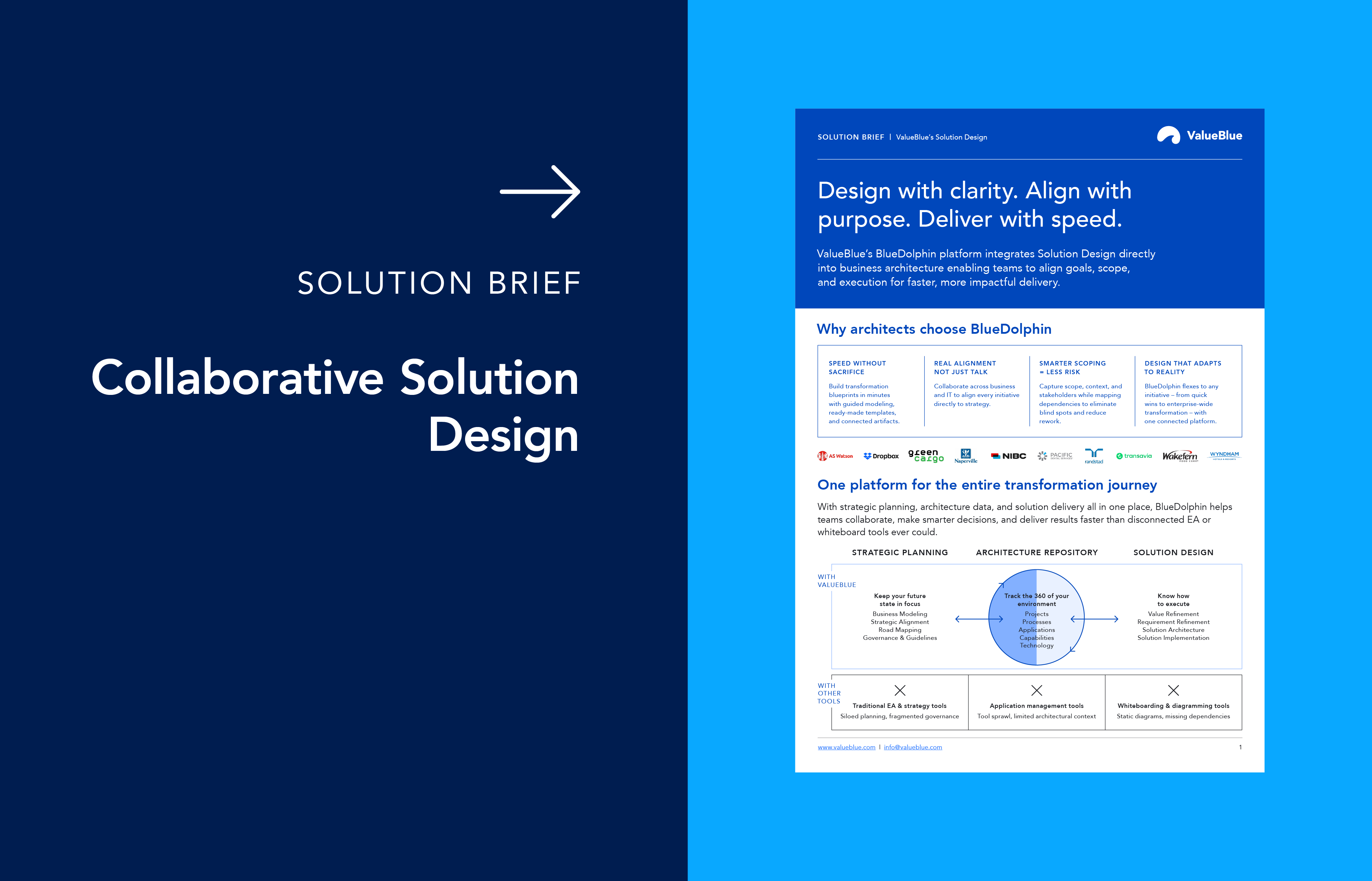
Solution design applies this architectural insight at the initiative level. It translates enterprise context into clear scope, structure, and decision guardrails for individual transformation efforts. By clarifying objectives, stakeholders, and dependencies early, solution design reduces ambiguity and limits costly rework during execution.
Together, Enterprise Architecture and solution design close the gap between intent and delivery. They transform architecture from an ivory-tower discipline into a practical decision system that supports faster alignment, better trade-offs, and more confident execution.
AI business transformation
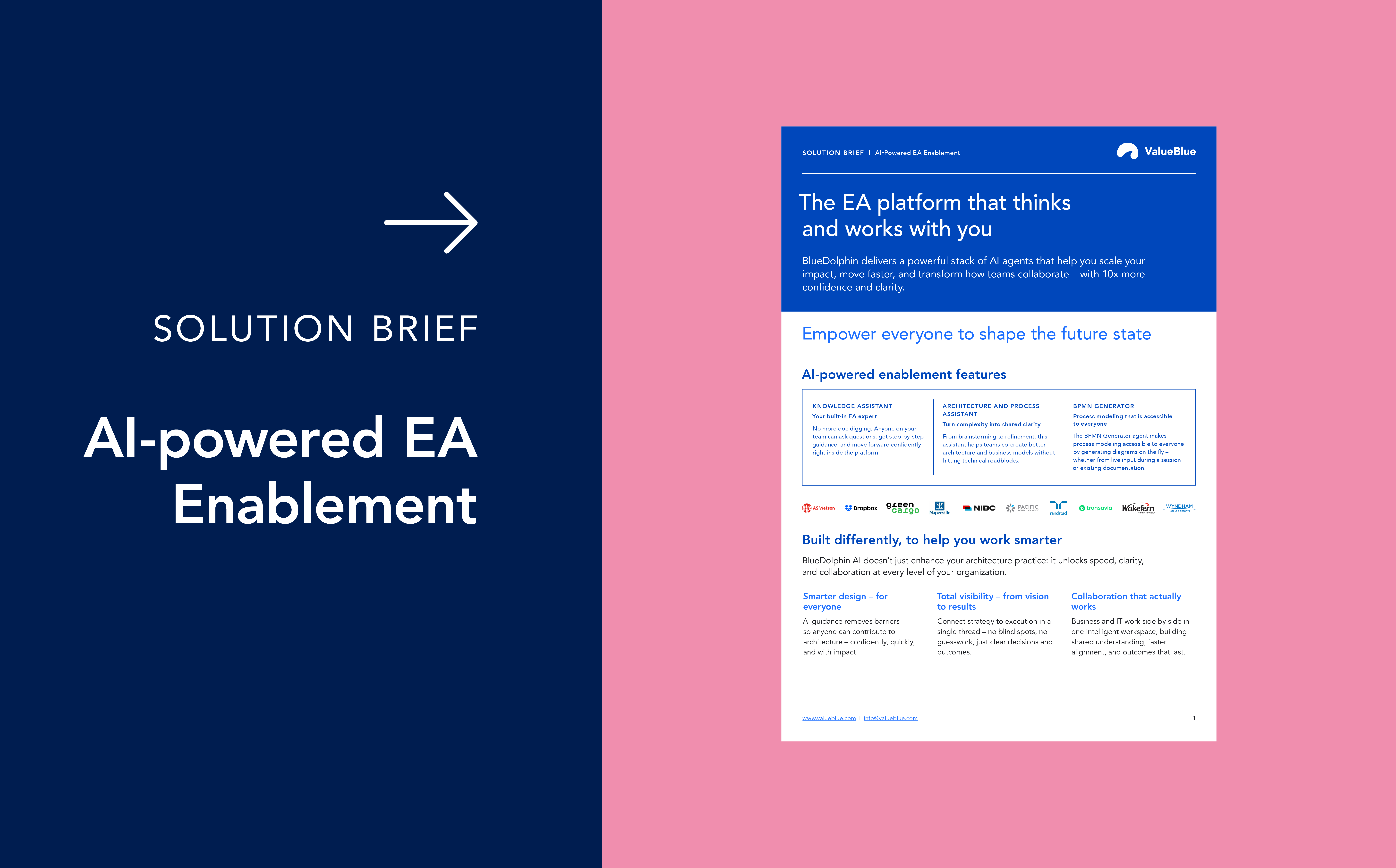
AI business transformation accelerates insight and collaboration by making enterprise knowledge accessible in real time. Instead of relying on static reports or specialist interpretation, leaders and teams can explore impacts, risks, and dependencies as questions arise.
Through natural-language interaction, AI allows both technical and non-technical stakeholders to engage directly with transformation data. This supports quicker understanding, more inclusive decision-making, and stronger alignment across business and IT.
AI business transformation succeeds only when grounded in trusted enterprise data and strong governance. Without a reliable foundation, AI does not create clarity. It amplifies noise. When paired with high-quality architecture data and clear decision context, AI becomes a powerful enabler of better, faster business transformation.
Examples of business transformation in practice
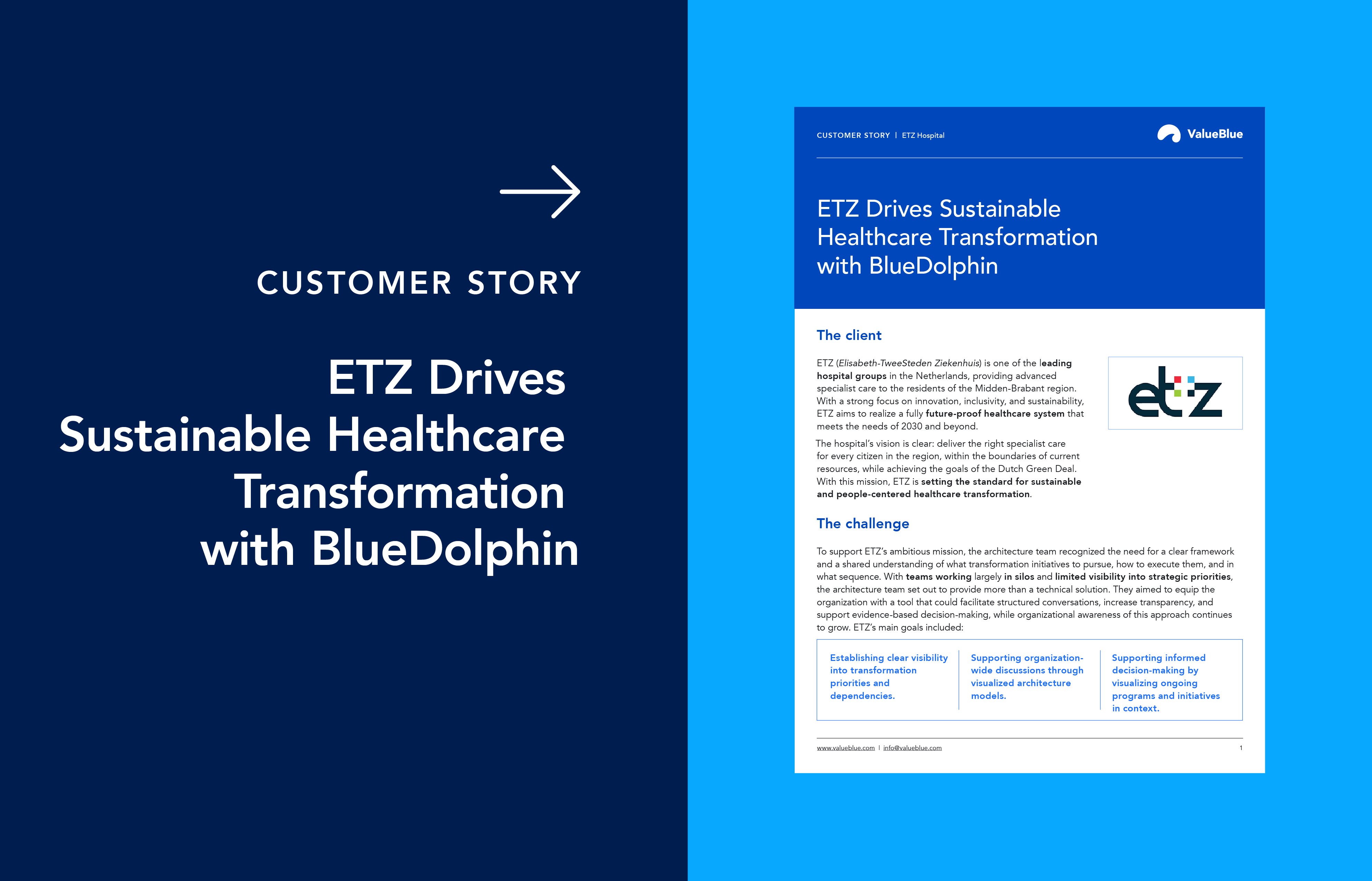
A large healthcare services organization set out to modernize its digital front door while reducing operational costs. Multiple initiatives were launched across customer experience, core platforms, and data capabilities, but progress slowed as teams uncovered overlapping dependencies and conflicting timelines. By creating a shared view of capabilities, applications, and processes, leaders could see where initiatives intersected and where risks were concentrated. Applying solution design at the initiative level helped reshape scope and sequencing, allowing the organization to deliver meaningful customer improvements without disrupting critical clinical operations.
In another case, a global manufacturing company pursued a cloud migration to improve agility and reduce technical debt. Early phases focused primarily on infrastructure, resulting in unexpected impacts on supply chain processes, reporting, and integration with legacy systems. The organization shifted to a broader business transformation approach that connected migration decisions to business capabilities and value streams. With clearer visibility into impacts and dependencies, leaders adjusted priorities, reduced rework, and aligned technology change with measurable business outcomes rather than technical milestones alone.
Choosing the right business transformation consultancy
When evaluating business transformation consultants, look for:
- A strong execution focus, not just strategy
- Integrated Enterprise Architecture and solution design
- Support for continuous change rather than one-time programs
- Responsible use of AI to improve decision-making
The right business transformation consulting partner helps organizations build internal capability rather than long-term dependency.
From transformation initiatives to transformation capability
A business transformation that works is not a one-time effort. It is a repeatable capability. Organizations that succeed:
- Align business transformation strategy with execution.
- Use architecture and solution design as decision infrastructure.
- Apply AI business transformation to improve clarity and speed.
In a world of constant change, the goal is not to chase destinations. It is to guide the flow of change with clarity, speed, and impact.
Key takeaways
- Business transformation is a continuous capability, not a one-time program. Organizations that succeed treat transformation as an ongoing way of working, continuously aligning strategy and execution as conditions change.
- Most transformations fail due to misalignment, not lack of effort. Disconnected strategy, limited visibility into dependencies, and fragmented execution are the primary reasons transformation initiatives fall short.
- A strong business transformation strategy acts as a living decision framework. It guides prioritization, trade-offs, and sequencing across initiatives rather than relying on static plans or roadmaps.
- Enterprise Architecture and solution design are critical enablers of execution. Together, they provide shared context, reduce risk, and translate strategic intent into actionable, well-scoped initiatives.
- AI strengthens business transformation when built on trusted enterprise data. When grounded in strong governance and architecture, AI improves insight, accessibility, and decision speed across the organization.
- Business transformation consulting delivers the most value when it builds internal capability. The most effective consultants help organizations align, decide, and execute with greater confidence, rather than creating long-term dependencies.
- Successful transformation comes from better decisions, not more activity. Organizations that connect strategy, architecture, and execution can move faster without losing control or momentum.
Next steps: see business transformation in action
Understanding business transformation is only valuable if it translates into better decisions and real execution. Seeing how transformation works in practice is often the fastest way to assess whether your organization has the clarity, alignment, and insight it needs to move forward.
In a live demo, you can explore how organizations use shared enterprise context to:
- Connect business transformation strategy directly to execution.
- Reveal dependencies, risks, and impacts before decisions are made.
- Align the business and IT teams around a single source of truth.
- Use AI to make transformation insights accessible to leaders and teams.
If you are evaluating business transformation consulting services, reassessing your business transformation strategy, or exploring how AI business transformation can reduce complexity, the next step is not another presentation. It is about seeing how transformation can actually work end-to-end.
Book a demo today to see how business transformation moves from planning to execution, with clarity, speed, and confidence.
*
FAQ
What is the difference between business transformation and digital transformation?
Digital transformation focuses on using technology to improve systems, processes, or experiences. Business transformation is broader. It includes digital change, but also addresses strategy, operating models, capabilities, and culture to ensure technology changes deliver measurable business outcomes.
How long does business transformation typically take?
Business transformation is not a one-time initiative with a fixed end date. While specific programs may run for months or years, successful organizations treat transformation as a continuous capability, adapting strategy and execution as conditions change.
When should an organization engage business transformation consultants?
Organizations often engage business transformation consultants when change spans multiple teams, systems, or priorities, and internal alignment becomes difficult. Consultants can help create shared context, clarify trade-offs, and accelerate decision-making without replacing internal ownership.
What role does Enterprise Architecture play in business transformation?
Enterprise Architecture provides visibility into how capabilities, processes, applications, and data are connected. In business transformation, it helps leaders understand impacts and risks before decisions are made, supporting alignment between strategy and execution.
How does AI support business transformation?
AI supports business transformation by making enterprise knowledge more accessible and actionable. When grounded in trusted data and governance, AI can help leaders explore impacts, risks, and dependencies in real time, improving clarity and speed of decision-making.