
Many business transformation initiatives fail not because of strategy or technology, but because leaders cannot see how value is actually delivered end to end. Value stream mapping exposes fragmented visibility across people, processes, systems, and time, allowing Enterprise Architecture teams to focus improvement efforts on real outcomes rather than assumptions.
Table of contents
What is value stream mapping in Enterprise Architecture?
An example of value stream mapping in a business transformation
Why value stream mapping is important for continuous improvement
Value stream mapping vs process mapping in Enterprise Architecture
How to create a value stream map step by step
What value stream mapping reveals that organizations often miss
Common mistakes in value stream mapping
Value stream mapping for digital products and platforms
The role of Enterprise Architecture in value stream mapping
Key takeaways
What is value stream mapping in Enterprise Architecture?
Value stream mapping (VSM) is a practical way to see how work actually gets done – from the moment someone engages with your organization to the final outcome. Instead of documenting how processes are supposed to work, it shows what really happens across teams and tools.
For IT decision-makers, this matters because transformation initiatives often fail when investments are made without a clear view of how value will be delivered across the organization. In fact, some studies find that around 70 percent of digital transformation initiatives fail to meet their stated goals. Leaders invest in new platforms, automation, or operating models without an understanding of where value is actually created or lost. Often, each team fixes what they control, but no one fixes how everything connects. The experience still feels confusing or expensive, even though multiple teams can point to internal improvements.
Value stream mapping provides that missing visibility. It shows how work moves across business and IT, where handoffs slow delivery, and where systems and teams are misaligned. Instead of asking whether a process exists, VSM asks whether the experience delivers value in a way that justifies the investment.
This is why value stream mapping has become a key practice for organizations pursuing digital transformation and modernization. It gives IT and architecture leaders a shared, evidence-based view of how value flows today and where change will actually matter.
An example of value stream mapping in a business transformation
Consider a large enterprise undergoing a business transformation to improve customer onboarding for a digital service. Each team involved has invested in improvement. Marketing has streamlined lead intake. Sales has automated qualification. IT has modernized the application platform. Operations has refined approval workflows.
On paper, every function shows progress. Yet customers still experience long delays before they can use the service. Deals stall. Costs rise. Frustration grows.
A value stream map reveals why. Work moves quickly within individual teams but slows dramatically at handoffs between them. Ownership becomes unclear as requests move between systems. Approvals stack up. Rework increases because information is lost along the way.
Without VSM, each team continues to optimize in isolation. With it, leaders can see how the full journey actually works and focus business transformation efforts on the points where value breaks down, not just where activity is visible.
Why value stream mapping is important for continuous improvement
Understanding why VSM is important for continuous improvement requires a change in mindset. Many organizations focus on improving effectiveness within individual teams while overlooking how work flows end to end.
Value stream mapping exposes when time is lost, where ownership becomes unclear, and where users experience friction. This allows leaders to focus on improvement initiatives based on evidence instead of intuition.
Continuous improvement depends on knowing whether change actually improves outcomes. Value stream mapping establishes a baseline that enables teams to compare before-and-after states. If nothing changes in the experience or the outcome, the improvement effort has not delivered value.
By grounding improvement discussions in observable reality, VSM helps organizations move beyond isolated optimization toward real progress.
Value stream mapping vs process mapping in Enterprise Architecture
Value stream mapping vs process mapping highlights an important distinction in how organizations analyze work.
Process mapping focuses on documenting activities and decision points. It regularly reflects how work is intended to be performed and is typically owned by managers or governance teams. These maps are useful for compliance and standardization, but often miss observational factors.
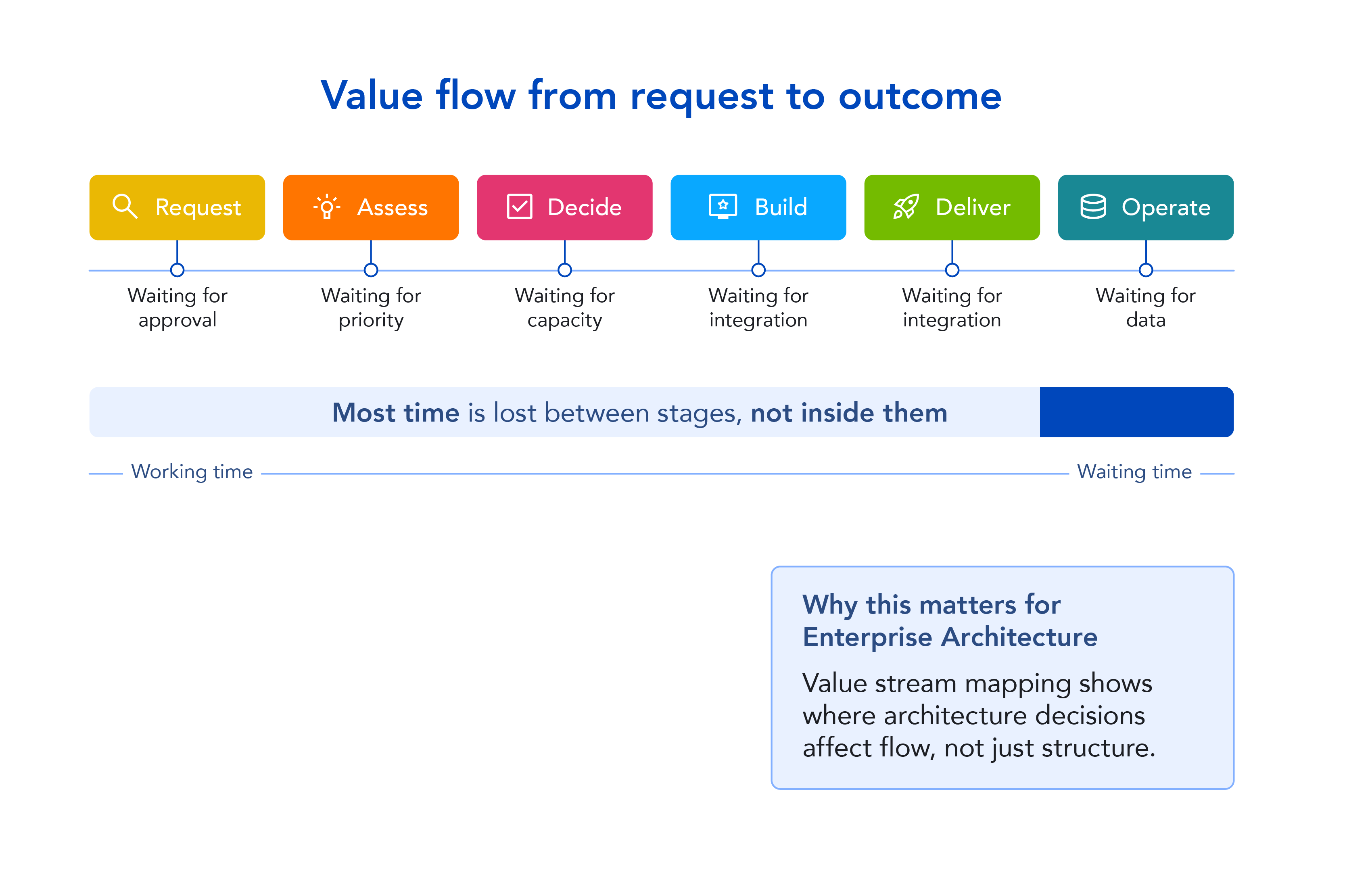
Value stream mapping focuses on how value is experienced by the user. It captures delays, handoffs, waiting periods, and rework that occur between formal steps. Ownership is shared across teams because value rarely flows through a single function.
For Enterprise Architecture teams, this distinction matters. Process maps explain structure. Value stream maps explain impact.
How to create a value stream map step by step
Teams often search for "how to create a value stream map step by step", expecting a highly technical method. This section provides a VSM process explained for beginners, focusing on how to observe real work, capture delays, and understand how value actually flows across teams. In practice, the most important steps are observational and coordinated.
A practical approach includes:
- Defining the user and the value they expect at the end of the journey.
- Identifying where engagement begins, including research and initial contact.
- Documenting every interaction, delay, and handoff across teams and systems.
- Capturing timing, waiting periods, and rework.
- Validating findings with the people performing the work.
- Identifying opportunities where value can be delivered faster or with less friction.
The objective is clarity, not perfection. A value stream map should reflect reality, even when that reality is uncomfortable.
What value stream mapping uncovers that organizations often miss
One of the most valuable aspects of value stream mapping is what it surfaces that organizations tend to overlook.
Waiting time is a common blind spot. Delays caused by approvals, missing information, or handoffs often exceed the time spent performing actual work. These delays shape user perception far more than internal efficiency metrics.
VSM also reveals disconnects between departments. Teams may improve their own work without realizing they are creating friction downstream. Mapping the full journey makes these trade-offs visible.
Finally, value stream mapping highlights where assumptions replace evidence. Leaders often describe how work should happen, while users experience something very different. Mapping bridges that gap.
Common mistakes in value stream mapping
Despite its simplicity, value stream mapping is frequently misapplied.
Common mistakes include:
- Treating VSM as a documentation exercise rather than a discovery process.
- Relying only on senior stakeholders instead of involving users and practitioners.
- Ignoring delays, rework, and informal communication.
- Jumping to solutions before fully understanding the problem.
- Focusing on tools or systems instead of outcomes.
These mistakes limit insight and reduce trust in the results. Effective value stream mapping requires openness and a willingness to observe reality as it is.
Value stream mapping for digital products and platforms
VSM stream analysis for digital products has become increasingly important as organizations rely on platforms, applications, and digital services to deliver value. In practice, VSM stream analysis helps IT leaders see how value moves through modern, software-driven environments. Digital workflows often move quickly within systems but slow down at handoffs between teams, approvals, or data dependencies. These delays are easy to overlook because the work itself is intangible.
Value stream mapping helps digital teams understand how ideas move from concept to delivery. It highlights where automation accelerates value and where it masks inefficiencies.
For Enterprise Architecture teams, VSM stream analysis for digital products supports better alignment between technology investments and business outcomes.
The role of Enterprise Architecture in value stream mapping
Enterprise Architecture plays a critical role in scaling VSM beyond isolated initiatives.
Architecture teams provide the context needed to connect value streams with capabilities, systems, and roadmaps. They help ensure insights from value stream mapping inform prioritization and investment decisions.
By maintaining a holistic view of the enterprise, Enterprise Architecture enables organizations to move from isolated improvements toward coordinated change. Value stream mapping becomes part of a broader story rather than an isolated artifact.
When value streams are connected to capabilities and strategic objectives, organizations gain clarity on where change will deliver the greatest value.
Key takeaways
- Value stream mapping focuses on how value is actually delivered, not how it is intended.
- It captures delays, handoffs, and friction that traditional documentation misses.
- Understanding why value stream mapping is important for continuous improvement requires focusing on outcomes.
- Value stream mapping vs process mapping highlights the difference between activity and experience.
- VSM stream analysis for digital products supports modern service delivery and transformation.
See value stream mapping in action
Value stream mapping becomes far more powerful when insights are connected to capabilities, systems, and execution within a single shared view. Enterprise Architecture teams need more than static diagrams to sustain improvement over time.
With BlueDolphin, teams can model value streams alongside business capabilities, applications, and roadmaps. This makes it easier to identify friction, prioritize change, and track whether improvements are delivering real outcomes.
Book a demo to see how BlueDolphin helps Enterprise Architecture teams turn value stream mapping into continuous, measurable improvement.
FAQ
What is the value stream mapping process?
The value stream mapping process starts with observing real work and documenting how users experience value from start to finish. Rather than relying on documented procedures, teams map what actually happens across people, systems, and handoffs. The goal is to create a shared, evidence-based view of how value flows today, including delays, rework, and friction that affect outcomes.
How detailed should a value stream map be?
A value stream map should be detailed enough to capture meaningful delays, handoffs, and timing without becoming overly complex. The purpose is clarity, not exhaustive documentation. If the map helps teams see where value slows or breaks down, it is detailed enough to support improvement.
Who should participate in value stream mapping?
Value stream mapping should involve users, practitioners, and cross-functional stakeholders who perform or support the work being mapped. Including people closest to the work helps ensure the map reflects reality rather than assumptions. This shared participation also builds trust in the findings and alignment on next steps.
Can value stream mapping apply outside manufacturing?
Yes. While value stream mapping originated in manufacturing, it applies equally to services, digital products, and enterprise operations. Any environment where value flows across multiple teams, systems, or decision points can benefit from understanding how that flow actually works.
How do organizations know if value stream mapping worked?
Value stream mapping is successful when its insights lead to measurable improvement in outcomes or experience. If teams can reduce delays, eliminate rework, or improve the end-to-end journey based on what the map revealed, the effort has delivered value. If nothing changes, the mapping exercise did not translate into impact.