
Breaking Down Silos: Intelligent Collaboration in EA Across Departments
Breaking down silos in Enterprise Architecture (EA) means turning architecture from an isolated expert activity into a shared way of working that connects business, IT, and change teams across departments. When EA becomes collaborative, practical, and supported by modern tools, it stops being paperwork and starts driving real strategy, delivery, and business results.
Breaking down silos in Enterprise Architecture
In many companies, Enterprise Architecture still lives in an “Ivory tower”: architects draw landscapes while business and delivery teams run projects on their own. This potentially creates duplicate systems, confusing roadmaps, and transformation programs that cost a lot but deliver less than expected.
Silos also create multiple versions of the truth. Strategy lives in slide decks, process diagrams live in separate tools, and integration details sit in local spreadsheets. Without a shared view of capabilities, processes, applications, data, and infrastructure, leaders cannot clearly see dependencies or risks, so every change takes longer and feels riskier.
From documentation to collaboration
Modern Enterprise Architecture leaders are changing the role of architecture from “documentation” to “collaboration”. Instead of static documents, they build living, visual models of how the business and IT fit together, so non-architects can actually use them in everyday decisions.
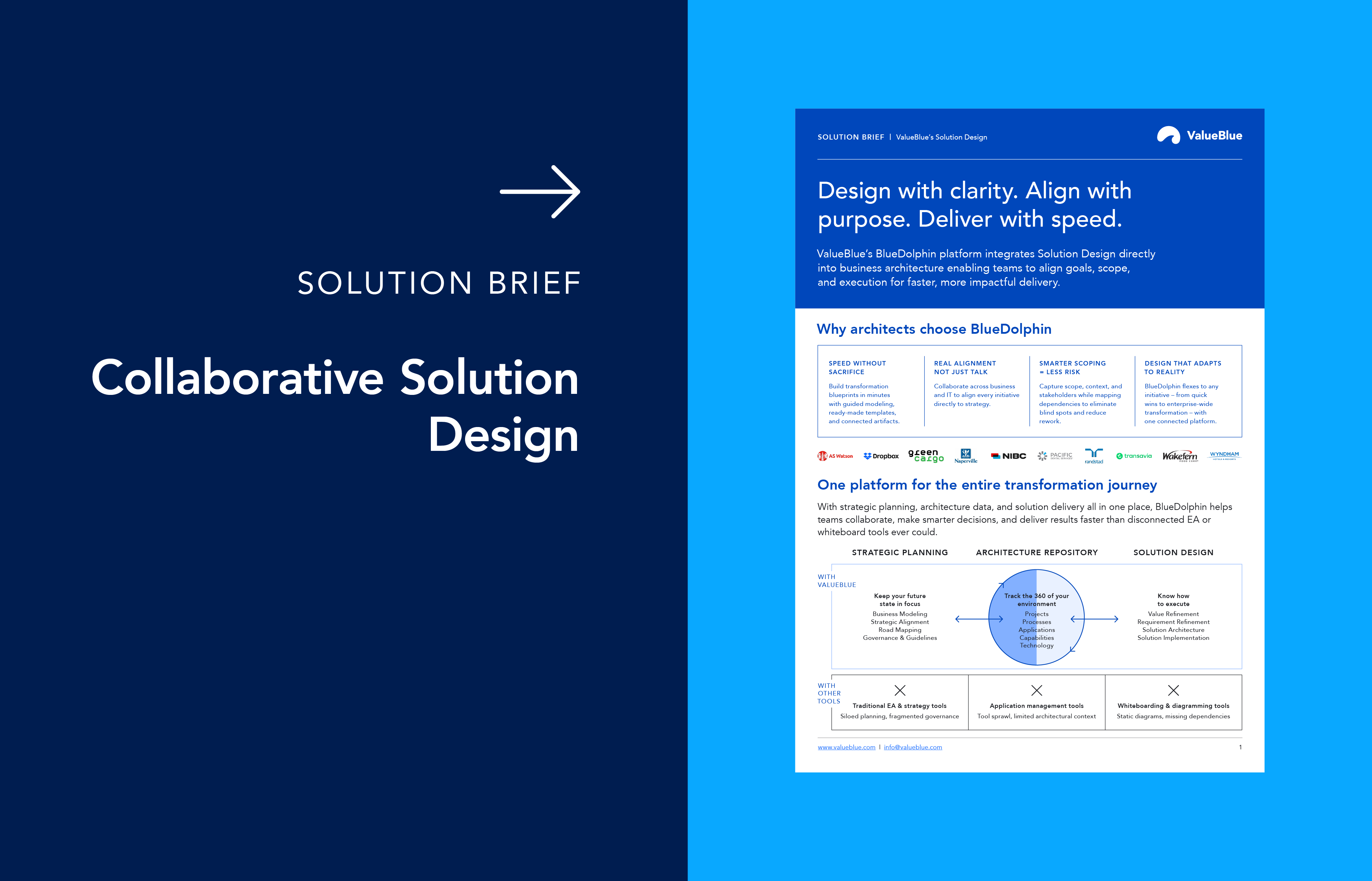
Platforms like ValueBlue’s BlueDolphin show what this looks like in practice by bringing application portfolio management, business process management, data management, and project architecture together in one cloud-based collaboration space. Teams work on shared models that stay up to date and link directly to real initiatives like cloud migrations, ERP upgrades, and AI projects.
What “intelligent collaboration” really means
“Intelligent collaboration” is more than storing EA diagrams in a shared drive. It uses data, automation, and AI to guide decisions across departments. Enterprise Architecture becomes a hub where strategy, architecture, and execution come together, giving real-time insight to executives, managers, and product teams.
Key elements include:
- One visual source of truth for processes, applications, data, and infrastructure that everyone can understand.
- Impact analysis that shows how a change in one area will affect other departments, systems, and projects before anything is approved.
- Dashboards and presentations that clearly show trends, risks, and options for different audiences, helping people line up around the same plan.
How collaboration breaks down silos
Every department tends to optimize for its own goals: sales for revenue, operations for efficiency, IT for stability, and finance for cost control. Collaborative Enterprise Architecture connects these views by mapping end-to-end value streams and capabilities, so everyone sees the whole flow from the customer request to delivery and billing. A “value stream” is simply the set of steps that create value for a customer or user from start to finish.
Cross-functional workshops, shared future-state designs, and “federated” decision models bring business, IT, and change teams into the same conversations. A “federated” decision model means decisions are made by several teams that share common rules, rather than by a single central group deciding everything. Instead of a central Enterprise Architecture group blocking decisions, shared rules and principles let local teams decide quickly while staying within a common architecture framework.
Enterprise Architecture collaboration focus areas
When EA becomes collaborative, it shows up in very concrete ways across the organization. It is not just a new governance model or a different set of diagrams; it changes how people manage applications, improve processes, handle data, and plan projects. The focus areas below show where intelligent collaboration in Enterprise Architecture has the biggest impact and how it helps departments work together instead of in isolation:
|
Focus area |
How it breaks silos |
Example benefits |
|
Application portfolio management |
Gives all departments visibility into which applications exist and who owns them. |
Identifies redundant tools, cuts spend, and aligns technology with business goals. |
|
Business process management |
Maps processes that cross department lines from start to finish. |
Exposes handoffs and bottlenecks that single teams cannot see on their own. |
|
Data management |
Clarifies who owns which data and how it flows across the organization. |
Improves data quality for reporting, compliance, and AI and analytics. |
|
Project & portfolio architecture |
Links projects to capabilities, processes, applications, data, and technology. |
Reduces conflicting projects and improves on-time, on-budget delivery. |
The role of AI and automation
As organizations expand their collaborative Enterprise Architecture practices, they quickly run into a new challenge: scale. Keeping models current, running impact analyses, and tailoring views for different stakeholders can become overwhelming if everything is manual. This is where AI and automation step in as force multipliers for collaborative Enterprise Architecture.
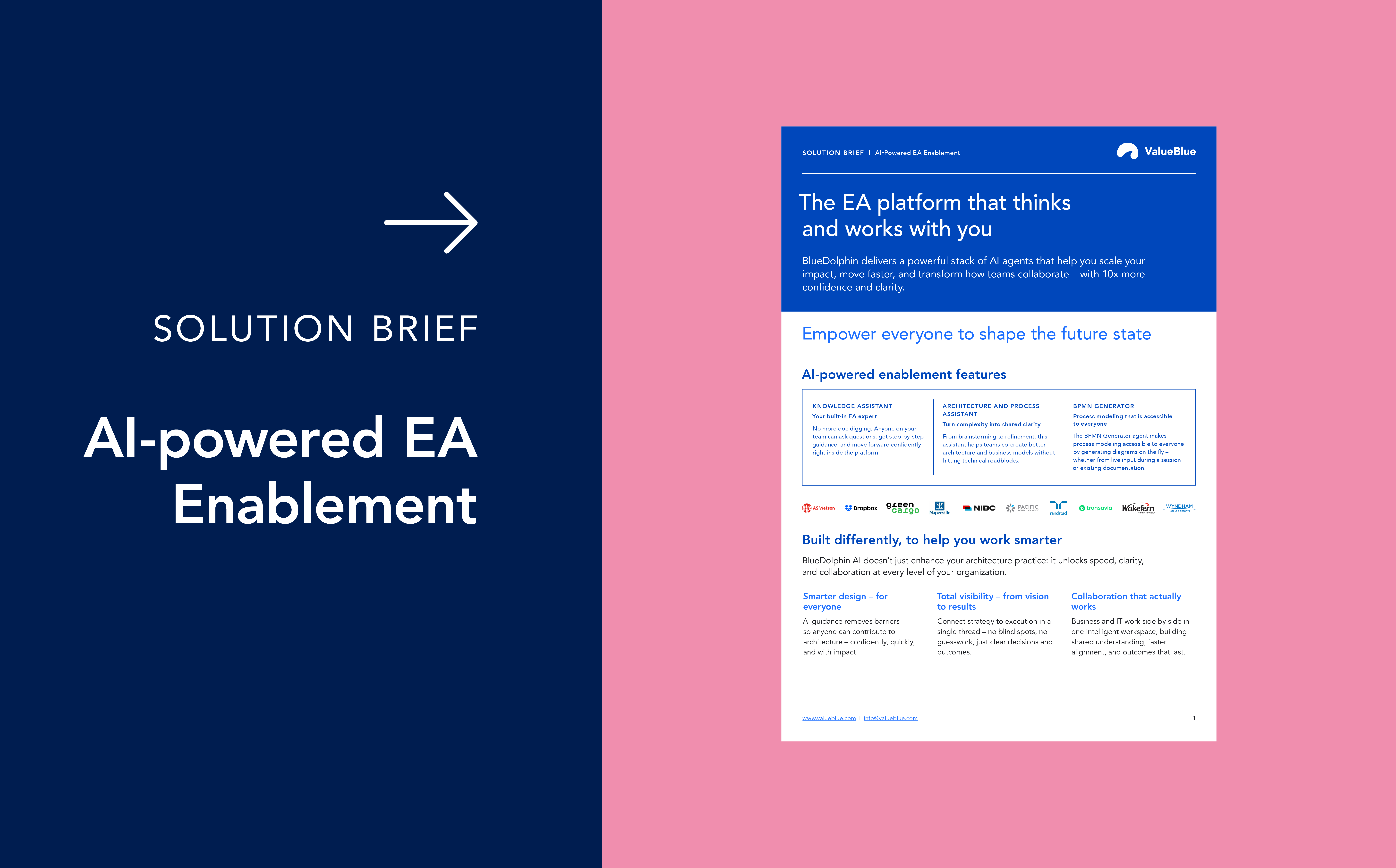
AI is changing EA from a slow, manual activity into something faster and more intelligent. AI can help generate initial model drafts, spot inconsistencies, and highlight underused, risky, or overly expensive systems. On collaborative Enterprise Architecture platforms, AI-powered dashboards and smart views turn raw architecture data into clear visuals. People see current information in minutes instead of waiting for updated slides. This frees architects from repetitive documentation, allowing them to spend more time working directly with business and IT leaders to solve real problems.
Governance that helps, not slows
Traditional Enterprise Architecture governance often adds to the silo problem by centralizing decision-making and adding heavy approval steps. Intelligent collaboration flips this around by setting clear rules, shared standards, and lightweight decision flows built into tools and day-to-day processes.
A good model combines company-wide principles with local ownership. Cross-functional teams make daily choices within clear guardrails, while all stakeholders help maintain the shared models; architects govern and maintain the quality check. This lets teams innovate and move fast, while still protecting security, cost, and consistency.
Practical steps to enable intelligent collaboration
Companies that want to move from siloed Enterprise Architecture to intelligent collaboration can start with a few concrete steps.
1. Reconnect Enterprise Architecture with strategy and value
Make sure architecture work clearly supports business goals, value streams, and key capabilities, not just technical layers. For every model, roadmap, and guideline, make it clear which outcomes it supports, such as better customer experience, lower cost, or lower risk.
2. Create a shared, visual source of truth
Bring process, application, data, and infrastructure information together in one collaborative platform. Replace scattered documents and diagrams with shared views. Use simple, consistent visuals and role-based views so that executives, managers, and specialists can all understand the same information without needing Enterprise Architecture jargon.
3. Embed collaboration into daily work
Schedule regular cross-functional architecture sessions around major initiatives instead of doing EA in isolation. Run joint workshops, shared retrospectives, and short “architect joins the team” rotations so architects and domain experts learn each other’s context and language. Even simple habits, like inviting architects to early planning meetings, can make a big difference.
4. Use data and AI to guide decisions
Introduce impact analysis that shows the full effect of proposed changes on systems, integrations, processes, and other projects. Use AI features to surface insights and create tailored views for different roles, helping leaders make faster, better-aligned decisions with less guesswork and fewer surprises late in projects.
5. Measure and communicate outcomes
Track results from collaborative EA, such as reduced project delays, lower application costs, or faster impact assessments. Share simple, clear metrics with leadership and teams to prove that Enterprise Architecture is helping break down silos and deliver value, not slowing things down. Over time, this builds trust and makes it easier to involve EA earlier in important decisions.
Turning Enterprise Architecture into a team sport
When Enterprise Architecture is collaborative, data-driven, and easy to understand, it becomes the connective tissue of the enterprise. Instead of a side activity focused on diagrams, it becomes a shared, intelligent way of working that links strategy, change, and operations across every department.
Ready to see how collaborative EA can break down silos in your organization? Book a personalized demo today and explore what this approach could look like in your own landscape.