
Application Portfolio Management (APM) is meant to bring clarity to a growing application landscape. Yet in many organizations, it becomes an inventory exercise or one-time rationalization effort that never quite connects to real decision-making.
As application landscapes grow more complex, Enterprise Architecture leaders are asked to reduce costs and risk, modernize platforms, and support digital transformation initiatives. At the same time, they are working with incomplete data, fragmented ownership, and portfolios that change faster than documentation can keep up. In this context, Application Portfolio Management becomes less about documentation and more about enabling informed, repeatable decisions.
In this guide, we explore what Application Portfolio Management really is, how it works in practice, and why it plays such a critical role in connecting business strategy, Enterprise Architecture, and execution. We also look at common reasons APM efforts stall and outline the principles, best practices, and tools that help Enterprise Architecture leaders make Application Portfolio Management a sustainable, decision-focused discipline rather than a one-time cleanup project.
Table of Contents
What is Application Portfolio Management and how does it work?
Why Application Portfolio Management breaks down in practice
Application Portfolio Management and Enterprise Architecture
What Application Portfolio Management is not and why it matters
Application Portfolio Management vs Technology Portfolio Management
Application Portfolio Management maturity
The core building blocks of effective application portfolio management
Key Application Portfolio Management deliverables Enterprise Architecture leaders rely on
Application Portfolio Management tools and software
How BlueDolphin supports Application Portfolio Management
What Enterprise Architecture leaders can do now to strengthen APM
What is Application Portfolio Management and how does it work?
Application Portfolio Management is the practice of governing and optimizing an organization’s application landscape to support business objectives. It provides a structured way to understand what applications exist, why they exist, how well they perform, and what role they should play going forward.
At its core, APM helps organizations answer a deceptively simple question: which applications should we keep, invest in, modernize, replace, or retire?
A practical way to think about Application Portfolio Management is as a decision support system rather than a static inventory. APM does not stop at listing applications. It continuously evaluates applications across dimensions such as business value, technical health, cost, risk, and strategic fit. This enables leaders to make informed, repeatable decisions about where to focus investment and where to reduce complexity.
Effective Application Portfolio Management typically involves several interconnected activities:
- Establishing a shared view of the application landscape, including ownership, lifecycle stage, and dependencies
- Assessing applications against consistent criteria tied to business and technology priorities
- Classifying applications based on their future role in the portfolio
- Governing change over time as strategies, technologies, and business needs evolve
Rather than producing a single rationalization report, APM supports ongoing portfolio decisions. As new applications are introduced, business priorities shift, or technical risk increases, the portfolio view adapts to reflect reality.
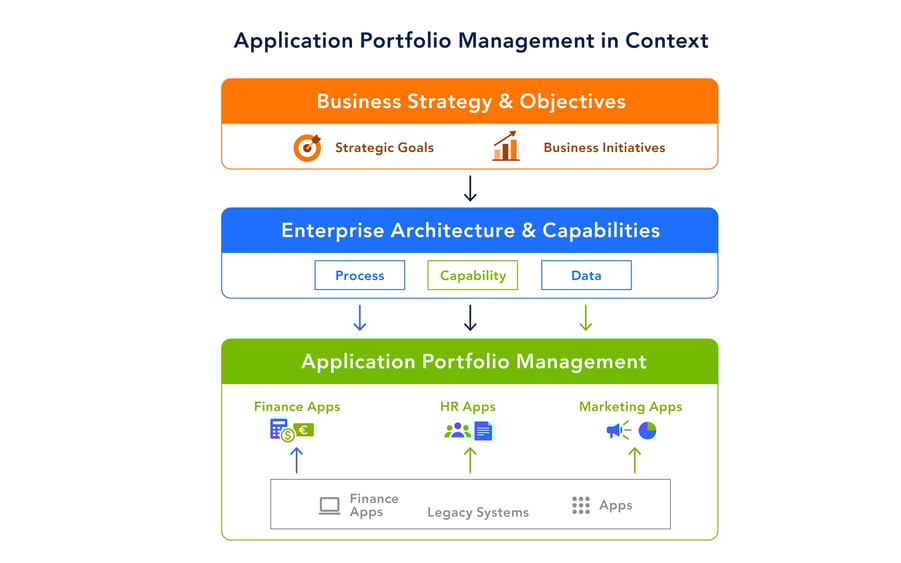
For Enterprise Architecture leaders, Application Portfolio Management is not an abstract exercise. It directly influences architecture roadmaps, investment decisions, and transformation outcomes. When APM works well, it creates confidence in decisions and alignment across business and IT. When it does not, portfolios become opaque, expensive, and increasingly difficult to change.
Why Application Portfolio Management breaks down in practice
Most organizations recognize the need for Application Portfolio Management. Many have attempted it multiple times. Yet APM initiatives often struggle to deliver lasting value.
The issue is rarely a lack of effort. More often, it is a lack of structure and shared understanding. Common breakdowns tend to appear in familiar ways:
- Application inventories become outdated almost as soon as they are completed. Ownership changes, shadow IT emerges, and integrations multiply faster than documentation can keep up.
- Assessments are performed inconsistently. Different teams evaluate applications using different criteria, making portfolio-level comparisons unreliable.
- Rationalization decisions are made once, but governance does not follow. Applications intended for retirement remain in place, while new applications enter the landscape without portfolio visibility.
- Business context is missing. Applications are assessed from a technical perspective, but their contribution to business capabilities and outcomes is unclear.
When these conditions exist, Application Portfolio Management becomes reactive. Teams respond to cost pressures, audit findings, or modernization mandates without a clear understanding of trade-offs or long-term impact.
In practice, APM breaks down when it is treated as a project rather than a discipline. Without a shared language, consistent criteria, and governance mechanisms, portfolio insights remain fragmented and difficult to act on.
Application Portfolio Management and Enterprise Architecture
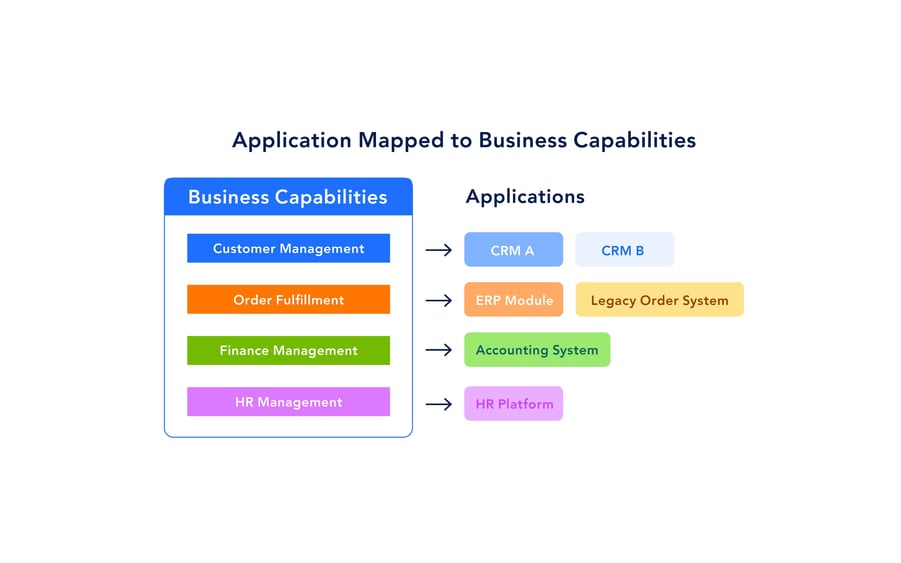
Application Portfolio Management and Enterprise Architecture are closely connected in practice, even though they are often treated as separate disciplines. APM focuses on understanding and governing the application layer, but on its own, it offers only a partial view. Enterprise Architecture provides the structural context that explains how applications support the organization and why some matter more than others at a given point in time. By linking applications to business capabilities and outcomes, EA enables evaluation of applications based on their contribution to the enterprise, not just their technical characteristics.
This perspective allows Application Portfolio Management to move beyond surface-level indicators such as age or cost. Applications are assessed based on the capabilities they enable and the value they deliver. What may appear redundant at a functional level can serve distinct purposes when viewed through a capability lens. In contrast, multiple applications supporting the same capability can signal fragmentation, complexity, and risk. This structured view enables more relevant, defensible portfolio decisions. When Application Portfolio Management is disconnected from Enterprise Architecture, several issues tend to surface over time. Applications are evaluated without a clear understanding of their roles in end-to-end business processes, making it difficult to assess their real impact when changes are proposed. Redundancies remain hidden because functional overlap is not visible across organizational or departmental boundaries. Modernization efforts focus on upgrading or replacing individual systems, while the underlying business capabilities those systems support remain fragmented or misaligned.
By anchoring Application Portfolio Management in Enterprise Architecture, organizations gain a shared reference point for decision-making. Business capabilities serve as a stable lens through which applications are assessed, compared, and prioritized. This creates clear traceability from strategy to applications and back to measurable business outcomes. Portfolio decisions become easier to explain, defend, and govern because they are grounded in an enterprise-wide understanding of how value is created.
Enterprise Architecture leaders play a critical role in making this connection work. By maintaining capability models, dependency views, and architectural standards, they provide the structure that allows Application Portfolio Management to function as part of a broader planning and governance system. Instead of standing alone as a periodic analysis, APM becomes an integrated discipline that supports continuous alignment between strategy, architecture, and execution.
What Application Portfolio Management is not and why it matters
Clarifying what Application Portfolio Management is not just as important as defining what it is. Many Application Portfolio Management initiatives struggle not because the concept is flawed, but because expectations are misaligned from the start. When APM is positioned as a quick fix or a narrowly scoped exercise, it almost always fails to deliver lasting value.
Application Portfolio Management is often misunderstood. In practice, it is not:
- A one-time cleanup effort. Application landscapes change continuously as new systems are introduced, legacy platforms persist, and business needs evolve. APM only delivers value when portfolio insight is maintained and governed over time.
- An IT-only exercise. While IT teams manage applications day-to-day, business stakeholders provide essential context on value, usage, and criticality. Without that input, portfolio decisions tend to overemphasize technical factors and miss business impact.
- A static inventory. Lists and spreadsheets quickly lose relevance when they are not tied to decision-making. An application inventory that does not inform prioritization, investment, or retirement decisions becomes an administrative burden rather than a strategic asset.
- Separate from strategy. Application decisions directly affect cost structures, risk exposure, and execution speed. When portfolio decisions are disconnected from strategic objectives, organizations risk investing in applications that no longer matter while underinvesting in the capabilities that do.
Understanding these distinctions matters because they directly shape how Application Portfolio Management is implemented. When APM is treated as an ongoing, collaborative discipline, it becomes a foundation for informed change. Instead of producing periodic reports, it supports continuous alignment between applications, business priorities, and Enterprise Architecture over time.
Application Portfolio Management vs Technology Portfolio Management
Application Portfolio Management is sometimes used interchangeably with Technology Portfolio Management (TPM), but in practice, the two serve different, complementary purposes. Understanding the distinction helps organizations avoid confusion about scope and ensures that portfolio decisions are made at the right level.
Where Application Portfolio Management focuses on decisions about individual applications and their role in supporting business capabilities, Technology Portfolio management operates at a higher level of abstraction. TPM looks across the entire technology landscape, including applications, infrastructure, platforms, and tools, to understand how technology investments collectively support the organization.
Rather than asking which applications should be modernized, consolidated, or retired, Technology Portfolio Management asks how different categories of technology balance cost, risk, and strategic value across the enterprise. This broader view helps leaders evaluate overall technology investment, identify systemic risk, and ensure that technology choices remain aligned with long-term strategy.
Technology Portfolio Management takes a broader view of the technology landscape. In addition to applications, it encompasses infrastructure, platforms, tools, and other technology assets that enable the organization to operate and evolve. This broader scope allows leaders to assess overall technology investment, balance risk and cost across the stack, and ensure that technology choices remain aligned with long-term strategy. While Application Portfolio Management focuses on specific systems, Technology Portfolio Management considers how those systems fit into a broader ecosystem.
The two disciplines work best when they are aligned. Application Portfolio Management provides the detailed insight needed to make informed decisions about individual applications, while Technology Portfolio Management helps organizations balance those decisions across the full technology portfolio. Together, they create a more complete picture of where to invest, where to simplify, and where to reduce risk.
For Enterprise Architecture leaders, clarity about this distinction is especially important. It helps ensure that application-level decisions support broader technology and business strategy, rather than being made in isolation or driven solely by local concerns.
Application Portfolio Management maturity
Application Portfolio Management does not become strategic overnight. Most organizations evolve through stages of maturity as they move from reactive documentation to structured, decision-driven governance. Early Application Portfolio Management efforts often begin with basic inventory and visibility. Over time, organizations introduce consistent assessment criteria, align applications to business capabilities, and embed portfolio decisions into investment and roadmap planning. The level of maturity directly influences how effectively applications are governed as a strategic asset rather than managed as operational overhead.
Mature Application Portfolio Management is characterized not by the volume of documentation, but by the quality and consistency of decisions. As maturity increases, Application Portfolio Management becomes integrated into Enterprise Architecture practices, financial planning, risk management, and strategic prioritization. Instead of periodic rationalization exercises, organizations establish continuous Application Portfolio Management governance that adapts as business needs, technology landscapes, and risk profiles evolve.
Organizations typically progress through stages such as:
- Ad hoc visibility. Applications are tracked inconsistently, with limited ownership and minimal linkage to business capabilities.
- Structured inventory. A centralized application inventory exists, and basic lifecycle and cost attributes are documented, but decisions are still episodic.
- Standardized assessment. Applications are evaluated using consistent criteria for value, cost, risk, and technical health, enabling portfolio-level comparison.
- Integrated governance. Application Portfolio Management decisions are linked to roadmaps, investment planning, and capability models, with clear accountability and review cycles.
- Continuous optimization. Application Portfolio Management is embedded in Enterprise Architecture and strategy processes, supporting ongoing, data-informed decision making across the enterprise.
Advancing Application Portfolio Management maturity does not require perfection at every stage. Even incremental improvements in structure, consistency, and governance can significantly improve visibility, reduce redundancy, and strengthen alignment between applications and business priorities.
The core building blocks of effective application portfolio management
Organizations often ask for Application Portfolio Management best practices or a step-by-step process. In practice, effective APM is better understood as a set of interconnected building blocks that evolve
Establishing the portfolio foundation
This building block focuses on creating a reliable baseline.
Key activities include:
- Defining what qualifies as an application within the organization
- Establishing ownership and accountability
- Capturing essential attributes such as lifecycle stage, cost, and usage
- Mapping applications to business capabilities
This foundation replaces assumptions with shared understanding. Without it, portfolio discussions remain subjective and difficult to scale.
Assessing application value, cost, and risk
Once the foundation is in place, applications must be evaluated using consistent criteria.
Assessments typically consider:
- Business value and criticality
- Technical health and maintainability
- Cost to run and cost to change
- Risk factors such as security, compliance, and obsolescence
Using a common assessment model allows applications to be compared across the portfolio, enabling prioritization and trade-off discussions grounded in evidence rather than opinion.
Governing Application Portfolio Management decisions over time
Assessment alone does not deliver value unless it leads to action.
This building block focuses on:
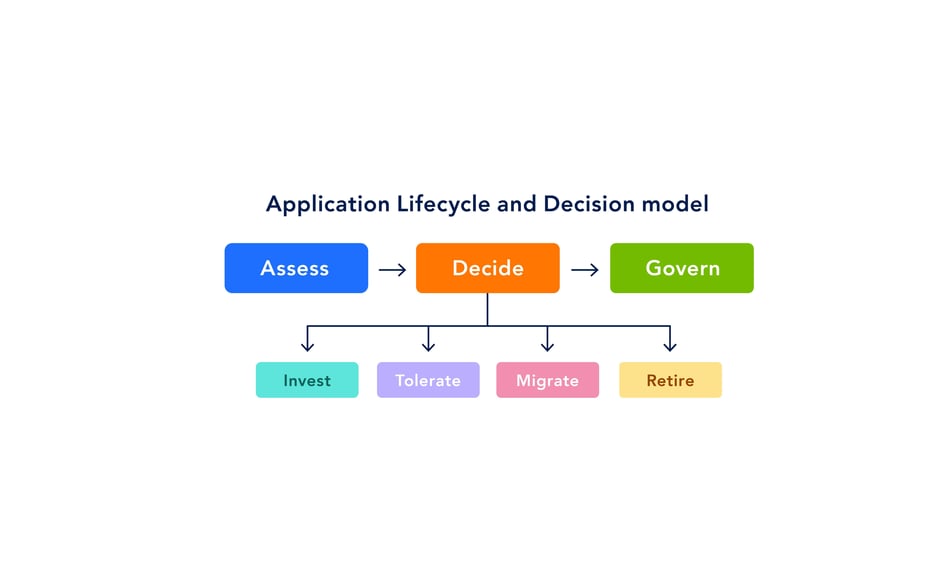
- Classifying applications based on their future role, such as invest, tolerate, migrate, or retire
- Linking decisions to roadmaps and investment planning
- Establishing governance to ensure decisions are revisited and enforced
Governance ensures that Application Portfolio Management remains relevant as conditions change. It turns insight into sustained improvement rather than one-off recommendations.
Key Application Portfolio Management deliverables Enterprise Architecture leaders rely on
Discussions about Application Portfolio Management solutions often focus on tools, but the real value lies in the deliverables that support decision-making
Application inventory
A structured, maintained view of all applications, including ownership, lifecycle status, and dependencies. This is the starting point for all portfolio insight.
Capability-mapped application views
Mapping applications to business capabilities reveals overlap, gaps, and critical dependencies. This enables business-aligned decision-making rather than purely technical optimization.
Lifecycle and classification models
Clear lifecycle definitions and classification frameworks help organizations decide which applications to invest in, modernize, replace, or retire.
Roadmaps and dashboards
Visual roadmaps and dashboards make portfolio decisions visible over time. They support communication, alignment, and ongoing governance across stakeholders.
These deliverables are not static artifacts. They evolve as strategies, technologies, and organizational priorities change.
Application Portfolio Management tools and software
Application Portfolio Management software should support the discipline, not replace it. Effective APM tools enable organizations to maintain a shared repository, apply consistent assessments, visualize dependencies, and support collaboration across business and IT. They help scale portfolio insight beyond spreadsheets and disconnected documents.
However, tools alone do not solve portfolio challenges. Without clear ownership, governance, and architectural context, even the best Application Portfolio Management tools will struggle to deliver value.
For Enterprise Architecture leaders, the goal is not tool adoption for its own sake. It is creating a planning environment where application decisions are transparent, repeatable, and aligned with strategy.
How BlueDolphin supports Application Portfolio Management
Enterprise Architecture platforms such as BlueDolphin help bring Application Portfolio Management into a broader architectural context. By connecting applications to business capabilities, processes, and strategic objectives, BlueDolphin enables organizations to see applications as part of an integrated system rather than isolated assets.
Key characteristics include:
- A shared repository that keeps portfolio information current
- Visual models that make dependencies and overlaps easy to understand
- Traceability from applications to capabilities and initiatives
- Support for governance and continuous assessment
Rather than positioning application portfolio management as a standalone activity, BlueDolphin supports it as part of an ongoing Enterprise Architecture practice.
What Enterprise Architecture leaders can do now to strengthen APM
Improving Application Portfolio Management does not require a perfect model or a complete data set. Practical steps EA leaders can take today include:
- Anchor application discussions in business capabilities.
- Apply consistent assessment criteria across the portfolio.
- Treat APM as a continuous discipline rather than a one-time project.
- Establish governance that links portfolio decisions to action.
Incremental improvements in structure and visibility can significantly improve decision quality over time.
See Application Portfolio Management in action
Application Portfolio Management becomes truly valuable when it is connected to Enterprise Architecture, strategy, and execution.
Book a demo to see how BlueDolphin supports continuous decision-making, not just one-off rationalization.