%20Image.png?width=1536&name=%5BBlog%5D%20What%20Is%20Business%20Process%20Management%20(BPM)%20Image.png)
Every organization has processes. Few can actually see them.
Work moves through emails, approvals, spreadsheets, and systems. People know their part of the job, but not always how it connects to the whole. When something slows down, no one is quite sure where the delay began or why.
Business Process Management helps make that invisible work visible. It shows how value flows to customers, where friction accumulates, and how operations support strategic goals.
Yet in many organizations, processes live in slide decks, departmental procedures, or in people’s heads. As change accelerates, that fragmentation makes it harder to improve performance, scale transformation, or respond to new demands.
In this guide we explain what Business Process Management is, how it works in practice, and why its connection to Enterprise Architecture helps turn strategy into execution.
Table of Contents
What is Business Process Management and how does it work?
Why BPM matters for Enterprise Architecture leaders
Business Process Management vs. Business Process Modeling
Why BPM initiatives break down in practice
The core building blocks of effective BPM
Key BPM deliverables organizations rely on
How BPMN enables shared understanding across the enterprise
Connecting BPMN to the broader architecture
Expanding participation in Business Process Management without losing rigor
How BlueDolphin supports Business Process Management
What Enterprise Architecture leaders can do now
From process clarity to strategic execution
What is Business Process Management and how does it work?
Business Process Management (BPM) stands for the discipline of designing, improving, and monitoring how work flows across an organization. It is a structured approach to identifying, analyzing, improving, and monitoring the workflows that enable an organization to operate.
It focuses on how workflows across people, systems, and information to deliver outcomes.
At its core, BPM helps organizations translate strategy into repeatable execution.
A practical way to think about BPM is as the operating logic of the business. Strategy defines where the organization wants to go. Processes define how it actually moves.
Without clear processes, strategy remains aspirational. With them, it becomes operational.
BPM examines how work actually happens, not how it is assumed to happen. It looks at handoffs between teams, decision points, system interactions, and the delays that quietly accumulate along the way. These insights make it possible to improve performance, reduce risk, and deliver more consistent outcomes.
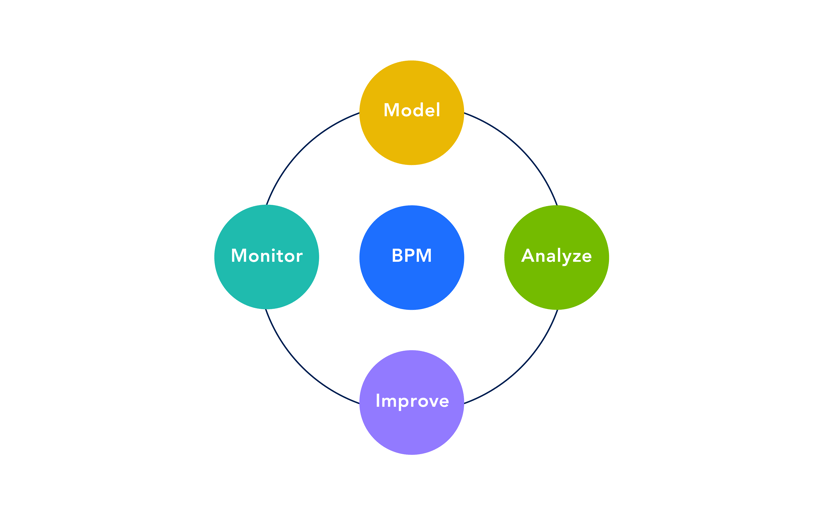
Effective BPM typically includes four continuous activities:
1. Modeling
Processes are visualized to show how work flows, who performs tasks, and where decisions occur. Modeling creates a shared picture of reality that stakeholders can understand and discuss. Instead of relying on assumptions or tribal knowledge, teams gain clarity on how work actually moves from start to finish.
2. Analysis
Workflows are evaluated to identify bottlenecks, risks, inefficiencies, and improvement opportunities. This stage often reveals duplicate steps, unnecessary approvals, manual workarounds, and dependencies that slow progress. Analysis turns visibility into insight.
3. Execution and improvement
Processes are optimized, automated, or redesigned to improve outcomes and efficiency. Improvements may include removing unnecessary steps, standardizing workflows, introducing automation, or improving system integration. The goal is not change for its own sake, but better performance and reliability.
4. Monitoring and optimization
Metrics and feedback loops ensure processes continue to improve as conditions change. Monitoring makes performance visible and supports continuous improvement rather than one-time fixes. As new technologies, regulations, or customer expectations emerge, processes evolve with them.
Importantly, BPM is not a one-time exercise. It is an ongoing discipline that helps organizations adapt and improve over time.
It also operates at multiple levels. Some processes are highly detailed and operational, such as invoice processing or incident response. Others span departments and shape customer experience, such as order fulfillment or onboarding. BPM helps organizations understand both the details and the broader flow of value.
This is not about documenting workflows for compliance. It is about understanding how value is created, where friction accumulates, and how performance can improve over time.
When organizations gain this visibility, they move from reacting to problems to proactively improving how work gets done.
Why BPM matters for Enterprise Architecture leaders
Business processes do not operate in isolation. They depend on applications, data flows, business actors, and infrastructure. Without that context, process improvement efforts often fail or create new problems elsewhere.
Enterprise Architecture provides the structural view of the organization. BPM provides the operational reality.
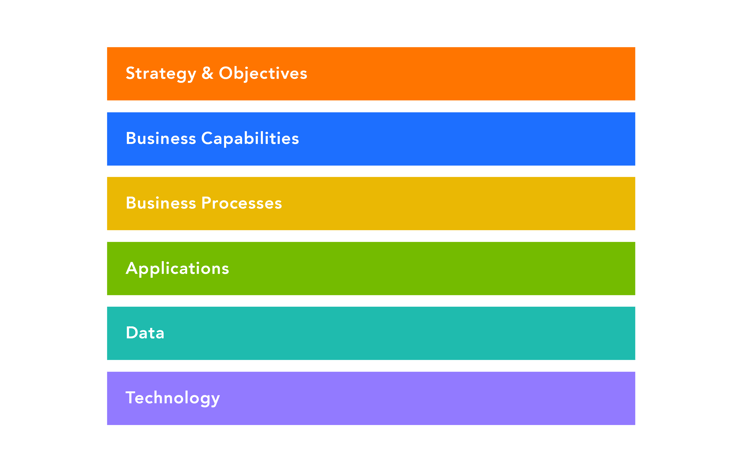
One shows how the enterprise is designed. The other shows how it actually runs.
When connected, they enable organizations to:
Align strategy with execution
Enterprise Architecture defines direction and long-term priorities. BPM ensures the processes that deliver daily work support those priorities. This connection turns strategic intent into operational behavior rather than leaving it as an executive vision.
Break down silos
Processes rarely stay within departmental boundaries. BPM reveals how work moves across teams, systems, and handoffs. Enterprise Architecture provides the context needed to resolve redundancies, improve integration, and eliminate friction between business units.
Improve agility
Organizations cannot adapt quickly if they do not understand how work flows today. Process visibility combined with flexible architecture allows teams to redesign workflows, introduce new technologies, and respond to change without creating disruption elsewhere.
Improve decision-making
Process performance data shows where time, cost, and risk accumulate. Architectural insight shows dependencies and impact across systems and capabilities. Together, they enable leaders to prioritize investments based on evidence rather than assumptions.
Support digital transformation
Enterprise Architecture ensures technology can scale and support transformation initiatives. BPM removes process bottlenecks and inefficiencies before automation and digitization expand them. This prevents organizations from accelerating broken workflows.
Organizations that integrate BPM and Enterprise Architecture gain a clearer understanding of how change actually affects operations. Instead of managing transformation in fragments, they can see how strategy, processes, technology, and outcomes connect.
Business Process Management vs. Business Process Modeling
These terms are often used interchangeably, but they are not the same. Understanding the distinction helps organizations avoid a common trap: investing in process diagrams without improving how work actually happens.
Business Process Management (BPM)
Business Process Management (BPM) is an ongoing discipline focused on improving how work flows across the organization to achieve business outcomes. Rather than a one-time initiative, it is a continuous capability that supports operational excellence and sustained improvement.
Within this discipline, organizations examine how work moves across teams, systems, and information to identify delays, risks, and opportunities for improvement. BPM ensures workflows remain aligned with strategic priorities and continue to evolve as business needs change.
BPM addresses questions such as:
-
How does work flow across the organization?
-
Where are delays, risks, or inefficiencies introduced?
-
Which processes are critical to strategic outcomes?
-
How can workflows be improved and sustained over time?
Business Process Modeling
Business Process Modeling is a technique used within Business Process Management (BPM) to visually represent workflows. Models illustrate activities, decision points, handoffs, and the roles or systems involved in completing work.
Business Process Management is the broader discipline. Modeling is one technique within that discipline, while BPM encompasses the full lifecycle of analysis, improvement, governance, and monitoring. Business process management software supports this lifecycle by enabling modeling, analysis, governance, and performance monitoring in a connected environment.
These visual representations make processes easier to understand, analyze, and discuss. They provide a shared reference point that stakeholders can use to identify improvement opportunities.
Modeling answers questions such as:
• What steps occur in this process?
• Who is responsible at each stage?
• Where do decisions or delays occur?
• How does work move between teams and systems?
Why the distinction matters
Modeling is one activity. BPM is the broader lifecycle that includes analysis, improvement, governance, and monitoring.
Organizations sometimes treat process modeling as the end goal. Diagrams are created, documented, and stored, but they are rarely revisited. Over time, they drift away from reality and lose their value.
Modeling without management produces diagrams that quickly become outdated.
Management without modeling lacks visibility and shared understanding.
When used together, modeling makes processes visible, and BPM ensures they improve and remain aligned with business goals.
This distinction is especially important for Enterprise Architecture leaders. Process models provide clarity, but BPM ensures those processes remain connected to capabilities, systems, and strategic outcomes.
Together, they create clarity, alignment, and continuous improvement.
Why BPM initiatives break down in practice
Many organizations invest in Business Process Management with the expectation that better documentation and workflow visibility will improve performance. Yet the anticipated value often fails to materialize.
The issue is rarely lack of intent. Leadership may support BPM, teams may create process maps, and improvement initiatives may begin with enthusiasm. What is usually missing is shared understanding and structural integration.
When BPM is treated as a documentation exercise rather than an operational discipline, it loses relevance quickly.
Common failure patterns include:
Processes documented once and never updated
Teams capture workflows during an initiative or audit, then store the diagrams in shared folders where they slowly become outdated. As systems evolve and workarounds emerge, the documented process no longer reflects reality.
Improvement efforts focused on departments instead of end-to-end workflows
Organizations often optimize within functional silos. A team may streamline its own tasks while unintentionally creating delays or friction downstream. Without an end-to-end view, local efficiency can degrade overall performance.
Process maps disconnected from applications and data
Workflows rely on systems, integrations, and data flows. When process documentation is not linked to the supporting architecture, improvement efforts overlook dependencies and introduce unintended consequences.
Limited stakeholder engagement because documentation is too technical
If process models rely on specialized notation or architectural language, business stakeholders disengage. Without broad participation, BPM becomes an isolated exercise rather than a shared operational tool.
No traceability between processes and strategic goals
Teams may improve workflows without understanding which processes drive strategic outcomes. This leads to incremental optimization rather than meaningful business impact.
Another frequent challenge is communication. Enterprise architects and process specialists often describe workflows using terminology that does not resonate with business stakeholders. When people cannot see how process work connects to their daily responsibilities or customer outcomes, engagement declines.
When BPM is treated as documentation instead of a shared operational language, alignment erodes and improvement stalls.
Successful BPM initiatives shift the focus from diagrams to shared understanding. They create visibility that people trust, language that stakeholders can engage with, and connections that link processes to strategy, systems, and outcomes.
Without that shift, BPM becomes shelfware. With it, it becomes a catalyst for operational clarity and transformation.
The core building blocks of effective BPM
Effective Business Process Management functions as an ongoing system rather than a one-time project. Organizations do not achieve lasting improvement by mapping processes once and moving on. They create value by making processes visible, improving them deliberately, and sustaining alignment as the business evolves.
While maturity levels differ, effective BPM consistently includes three interconnected building blocks.
1. Establishing process visibility
This stage focuses on understanding the current state.
Before processes can be improved, they must be understood as they actually operate, not as they were designed or assumed to work. Visibility exposes how work flows across teams, systems, and decision points.
Key activities include:
-
Mapping critical workflows
-
Identifiying stakeholders and roles
-
Linking processes to business capabilities
-
Documenting supporting applications and data
This step often reveals hidden complexity, manual workarounds, duplicated efforts, and informal decision paths that have evolved over time.
Process visibility creates a shared baseline for improvement. It allows stakeholders to discuss operations using a common reference point rather than individual perspectives.
Without this shared understanding, improvement efforts are based on assumptions instead of reality.
2. Analyzing and improving workflows
Once visibility exists, organizations can evaluate performance and identify opportunities for improvement.
This stage focuses on:
-
Identifying bottlenecks and inefficiencies
-
Assessing risks and compliance gaps
-
Standardizing processes where appropriate
-
Automating repetitive tasks
Analysis often reveals delays caused by approvals, handoffs, or data reconciliation. It can also uncover compliance risks, inconsistent practices, or unnecessary complexity that slows work down.
Improvement does not always mean redesigning a process from scratch. In many cases, small adjustments such as removing redundant steps, clarifying decision rules, or improving system integration produce meaningful gains.
Automation plays a role when it eliminates repetitive tasks or reduces manual error. However, automating a flawed process only accelerates inefficiency. Improvement should come before automation.
This is the stage where BPM moves beyond documentation into operational improvement.
3. Monitoring and governing processes
Improvement must be sustained to deliver long-term value.
As organizations evolve, new systems are introduced, regulations change, and customer expectations shift. Processes must adapt accordingly.
This stage includes:
-
Measuring performance and outcomes
-
Maintaining process ownership and governance
-
Updating models as change occurs
-
Ensurining continuous improvement
Monitoring makes performance visible and helps teams identify emerging issues before they become systemic problems. Governance clarifies accountability and ensures processes remain aligned with business priorities.
Process ownership is especially important. When no one is responsible for maintaining a workflow, it gradually deteriorates as workarounds accumulate.
Continuous improvement keeps BPM relevant. Feedback loops ensure that lessons learned, performance data, and operational changes inform future updates.
When monitoring and governance are in place, BPM becomes part of how the organization operates, not a one-time initiative.
Together, these building blocks create a cycle of visibility, improvement, and sustained alignment. Organizations that treat BPM as an ongoing discipline gain the ability to adapt processes as conditions change, rather than reacting after problems emerge.
Key BPM deliverables organizations rely on
Business Process Management produces tangible artifacts that make operations visible, understandable, and actionable. These deliverables provide a shared reference point that supports decision-making, improvement efforts, and strategic alignment.
Rather than serving as static documentation, they function as living assets that evolve as the organization changes.
Process models
Process models provide visual representations of workflows, showing tasks, decision points, actors, and handoffs.
They make work visible in a way that written procedures cannot. Stakeholders can see where approvals occur, where delays accumulate, and how responsibilities shift between teams or systems. This clarity supports analysis, training, and improvement.
Well-designed models also create a common language that enables both business and technical stakeholders to discuss operations using the same frame of reference.
Process architecture
Process architecture offers a structured view of how processes relate across the enterprise. It shows how operational workflows connect to value streams, business domains, and customer outcomes.
This perspective helps organizations move beyond isolated workflows and understand how processes work together to deliver value. It also reveals duplication, fragmentation, and gaps that may not be visible at the individual process level.
Process architecture enables leaders to prioritize improvement efforts based on overall impact rather than local efficiency.
Process performance metrics
Metrics translate process performance into measurable insight. Key performance indicators (KPIs) track efficiency, quality, risk exposure, and business outcomes.
Common measures include cycle time, error rates, rework, compliance adherence, and customer impact. These indicators help distinguish between activity and effectiveness, ensuring that improvement efforts focus on meaningful results rather than output volume.
When performance data is tied to process models, organizations gain visibility into where delays, costs, or risks originate.
Capability alignment
Mapping processes to business capabilities ensures improvement efforts support strategic priorities.
Capabilities represent what the organization must be able to do to deliver value. Processes represent how that work is performed. When these are aligned, leaders can see which workflows support critical capabilities and where improvement will produce the greatest strategic impact.
This alignment also helps prevent optimization of low-impact processes while critical capabilities remain constrained.
Process-to-application mapping
Linking workflows to supporting applications reveals dependencies, integration points, and potential risks.
Processes rarely operate independently of technology. They depend on systems, data flows, and infrastructure. Mapping these relationships helps organizations understand how system changes affect operations and how process improvements may require technical updates.
This connection supports impact analysis, improves data consistency, and reduces surprises during transformation initiatives.
Together, these deliverables transform process knowledge from fragmented documentation into a connected operational view. They provide the clarity needed to analyze performance, guide improvement efforts, and ensure that operational changes remain aligned with strategy.
When maintained and connected, these artifacts become a foundation for informed decision-making and sustainable transformation.
How Business Process Model and Notation (BPMN) enables shared understanding across the enterprise
Business Process Model and Notation (BPMN) provides a standard visual language for modeling business processes.
Its value lies in clarity and accessibility.
BPMN uses consistent symbols to represent activities, decisions, events, and flows. This makes workflows easier to understand at a glance, even for stakeholders who have no technical background.
Instead of reading lengthy documentation or interpreting complex diagrams, stakeholders can see how work progresses, where decisions occur, and where delays or risks may arise.
This visual clarity removes ambiguity and creates a shared understanding of how work actually happens.
BPMN allows stakeholders across the organization to engage with process discussions without requiring specialized expertise. Business leaders can see operational flow. Process owners can identify inefficiencies. Architects can understand dependencies. Teams gain a common frame of reference.
This accessibility is critical because process improvement requires participation beyond IT and architecture teams. When people understand the process, they are more likely to contribute insights and support change.
Connecting BPMN to the broader architecture
The real power of BPMN emerges when process models are connected to Enterprise Architecture languages such as ArchiMate and data models such as ERD.
Most BPM tools stop at process modeling. They create clear workflow diagrams but do not connect those workflows to capabilities, applications, data, or strategic objectives. Conversely, many Enterprise Architecture tools provide deep technical modeling but are too complex for business stakeholders to engage with directly.
Connecting BPMN with architectural and data models bridges this divide.
This integration creates a connected view of operations rather than isolated diagrams. Processes can be linked to business capabilities, applications, data entities, and technology infrastructure. Strategic objectives can be traced through capabilities into workflows and the systems that support them.
This connection allows:
-
Business stakeholders to engage without technical complexity
-
Architects to link processes to capabilities, applications, and data
-
Organizations to maintain traceability from strategy to execution
Process visualizations can be translated into architectural views and connected to objectives, capabilities, applications, data, and infrastructure. This ensures that process improvements are not made in isolation but remain aligned with the broader enterprise landscape.
BlueDolphin brings these elements together in a single connected repository, linking BPMN, ArchiMate, ERD, capabilities, applications, and strategy to support shared understanding and informed decision-making across the enterprise.
Expanding participation in Business Process Management without losing rigor
Traditional architectural modeling can feel inaccessible to non-specialists. BPMN provides an entry point that is intuitive and practical, while integration with architectural models preserves the depth required for governance, planning, and transformation.
This multi-language integration expands participation while preserving architectural rigor. It enables more stakeholders to engage in enterprise change without overwhelming them with technical complexity.
When BPMN is used as a bridge between business understanding and architectural insight, organizations gain both clarity and alignment.
How BlueDolphin supports Business Process Management
Enterprise Architecture platforms help bring Business Process Management into a shared, connected environment. Instead of documenting workflows in isolation, organizations can link processes to strategy, capabilities, systems, and execution.
BlueDolphin supports this connected view by centralizing process insight and making relationships across the enterprise visible.
Process knowledge is consolidated into a shared repository, reducing duplication and ensuring stakeholders work from a consistent, up-to-date view. Workflows can be linked to business capabilities, applications, data, and infrastructure, providing clarity into dependencies and operational impact.
Process models created in BPMN can be connected to architectural views such as ArchiMate and related data models. This allows architects to evaluate downstream impacts while enabling business stakeholders to engage through intuitive visual process views.
By connecting processes with capabilities, systems, and performance insights, organizations gain greater visibility into operational constraints, improvement priorities, and transformation impacts. This integrated perspective supports better decision-making and reduces the risk of unintended consequences during change initiatives.
What Enterprise Architecture leaders can do now
Organizations do not need a fully mature Business Process Management (BPM) program to begin improving outcomes. Progress often starts with small steps that make work more visible, more connected, and easier to understand.
Practical actions to take now:
Treat processes as a living system
Workflows evolve as systems change, teams adapt, and new demands emerge. Keeping process models current ensures they remain relevant and trusted.
Anchor BPM efforts to capabilities and strategic outcomes
Rather than mapping everything at once, focus on workflows that support critical capabilities and measurable business goals.
Prioritize high-impact workflows
Processes that influence customer experience, regulatory compliance, or operational efficiency often present the greatest opportunities for improvement and risk reduction.
Map dependencies across applications, data, and infrastructure
Understanding these connections helps prevent unintended consequences and supports better decision-making during change initiatives.
Use BPMN to create shared understanding
Clear visual models enable business leaders, architects, and operational teams to engage in process discussions without technical barriers.
Establish feedback loops for continuous improvement
Monitor performance, capture lessons learned, and update models as conditions change so processes evolve alongside the organization.
When processes become visible, connected, and measurable, transformation becomes easier to manage and sustain.
From process clarity to strategic execution
Business Process Management is not just about improving efficiency. It is about understanding how value flows through the organization and ensuring that operations support strategic intent.
When BPM is connected to Enterprise Architecture, organizations gain the clarity needed to improve performance, reduce risk, and execute transformation with confidence.
Leaders can see how strategy connects to capabilities, how capabilities are delivered through processes, and how those processes depend on systems and data. Decisions become better informed. Change becomes more predictable. Improvement becomes continuous rather than reactive.
The result is not just better processes, but a more adaptable and resilient enterprise.
See how BlueDolphin uniquely connects BPMN, ArchiMate, ERD, capabilities, applications, and strategy in one integrated environment.
Book a personalized demo to experience how connected process and architecture insight accelerates transformation.